WORLDWIDE
Home / New Product
New Product
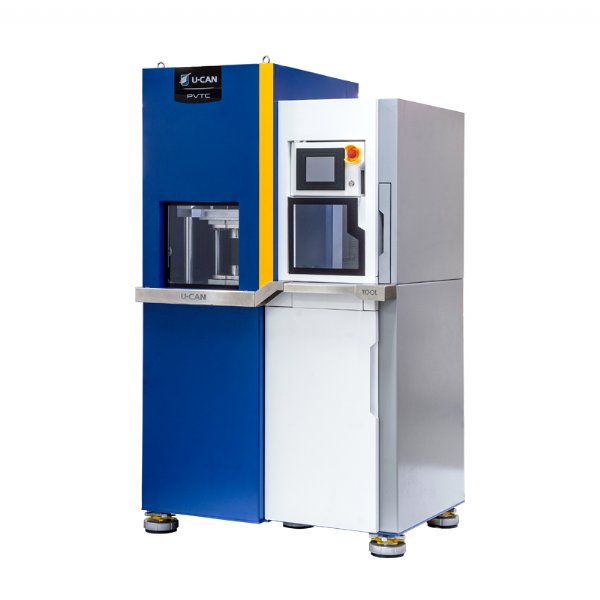
PVTC-A1
PVTC Analyzer
During IC packaging process, the curing reaction of the packaging material causes considerable shrinkage and warpage of the chip package body, which is one of the main reasons why the quality of the package body would be difficult to control.
PVTC is buid to solve this issue.
Features:
1. Measuring the slight volume(um) under different temperature, pressure
and degree of cure
2. Establishing the relationship between the specific volume and degree of
cure of material based on curing kinetics.(With DSC)
3. With the support of CAE software, it is possible to predict the compreh-
ensive dimensional changes at various stages(time variation) and
different locations(spatial variation)
Patents for PVTC-A1:
Taiwan: Invention No. I640770
USA: US 10,641,692 B2
European Economic Community: EP3410095
PVTC is buid to solve this issue.
Features:
1. Measuring the slight volume(um) under different temperature, pressure
and degree of cure
2. Establishing the relationship between the specific volume and degree of
cure of material based on curing kinetics.(With DSC)
3. With the support of CAE software, it is possible to predict the compreh-
ensive dimensional changes at various stages(time variation) and
different locations(spatial variation)
Patents for PVTC-A1:
Taiwan: Invention No. I640770
USA: US 10,641,692 B2
European Economic Community: EP3410095
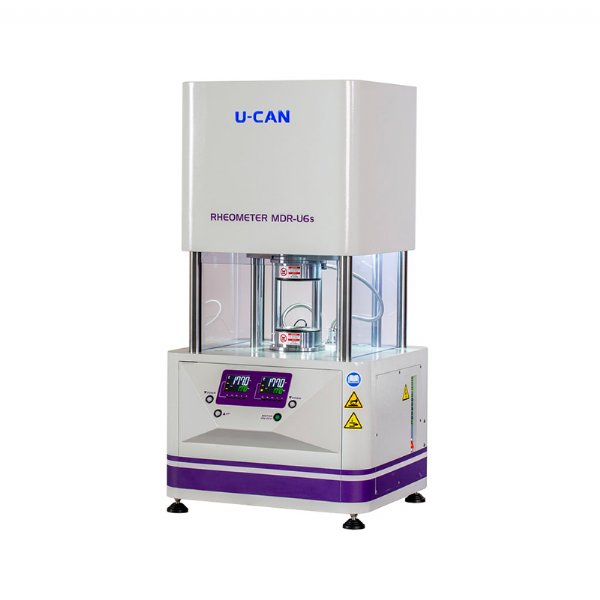
MDR-U6S
Rotorless Rheometer
1.Simple, quick installation.
2.Indicate test results as pass or fail using LEDs of different colors.
3.Great repeatability and reproducibility because of noise-resistance circuit and DFT algorithm.
4.New mechanical design to keep stable torque transmission.
5.Build in controller calculate and analyze the signal independently without computer.
6.Able to calibrate loss angle automatically.
7.It would not exceeding 2 min and 40 seconds when heating up from room temperature to the
equilibrium of 170℃±0.3℃
8.Time needed for changing temperature :
From 170℃ to 190℃ and reach the state of equilibrium 190℃±0.3℃.....within 55 seconds.
From 190℃ to 170℃ and reach the state of equilibrium 170℃±0.3℃.....within 1min and 40 seconds.
9.During testing, die chamber temperature will be redeemed to the tolerance of ±0.3℃ within 30±3 seconds from die closure.
10.By no means of overshooting nor of fluctuating, during recovering the test temperature, i.e., the
heating-up is carried out stably and gradually without fluctuation after die closure.
11.Key components are from US, Germany, and Japan.
2.Indicate test results as pass or fail using LEDs of different colors.
3.Great repeatability and reproducibility because of noise-resistance circuit and DFT algorithm.
4.New mechanical design to keep stable torque transmission.
5.Build in controller calculate and analyze the signal independently without computer.
6.Able to calibrate loss angle automatically.
7.It would not exceeding 2 min and 40 seconds when heating up from room temperature to the
equilibrium of 170℃±0.3℃
8.Time needed for changing temperature :
From 170℃ to 190℃ and reach the state of equilibrium 190℃±0.3℃.....within 55 seconds.
From 190℃ to 170℃ and reach the state of equilibrium 170℃±0.3℃.....within 1min and 40 seconds.
9.During testing, die chamber temperature will be redeemed to the tolerance of ±0.3℃ within 30±3 seconds from die closure.
10.By no means of overshooting nor of fluctuating, during recovering the test temperature, i.e., the
heating-up is carried out stably and gradually without fluctuation after die closure.
11.Key components are from US, Germany, and Japan.